The EarAware Book

Chapter 1 — The Awakening
Remember in the movie Jurassic Park when there’s a close-up shot of water in a glass rippling in concentric circles to a distant boom?
Boom.
Then another.
Next, the rearview mirror starts to shake.
Boom… Boom…
Then the car itself begins to tremble.
These were the thunderous footsteps of an approaching Tyrannosaurus rex.
Well, on rainy days in the parking lot of our old church, the puddles would ripple the same way. The large glass windows would tremble with each booming thud, thud, thud.
But these sounds were not from an approaching dinosaur. They were from the average everyday music worship set.
I think most sensible people could probably tell that if it was that loud in the parking lot, then it had to be much louder inside… and that maybe it wasn’t good for your ears. You might think twice about going in. Well… I obviously did not think like most sensible people.
I loved my church.
I loved my friends who ran it.
I loved the music.
I would plow right in and sit near the front rows. Sure, afterward I might have temporary deafness or ringing in my ears for a while, but I brushed it off. There was no way I was going to kill the vibe. These were my friends.
What troubles me most now is this: I am an ear doctor. I live and breathe hearing loss treatment. I see the damage noise can cause. I should have known better.
For years, patients came into my office saying things like:
“Doc, church has gotten unbearably loud.”
“It actually hurts.”
“My ears ring for days afterward.”
“My Apple Watch keeps warning me.”
“We finally had to stop going.”
And for years, I brushed it off. I smiled politely and reassured them the way many physicians do when we don’t fully agree. We pat them on the knee and say: “Now now…..”
“Hearing changes as we get older.”
“Modern worship is louder these days.”
“People seem to enjoy it.”
I even defended the churches.
Surely there were safety standards. Surely the sound engineers understood hearing risk. Surely somebody was driving the bus.
Well, guess what?
I was wrong.
Not because churches maliciously wanted to damage people’s hearing.
Not because musicians intended harm.
And not because sound engineers were careless.
I was wrong because I did not know what I did not know. I did not understand cochlear synaptopathy—hidden hearing loss. I did not understand how loud 85 decibels actually was. I did not understand how quickly “safe exposure time” collapses as sound levels rise. I did not understand the mathematics of sound dose and time exchange rates.
I knew loud blasts could destroy hair cells and cause hearing loss. Most people know that. What I did not know was that lower levels of sound—levels that do not kill hair cells outright—can still silently damage the tiny nerve connections that give hearing its clarity and richness.
You may not notice it immediately. You don’t suddenly go deaf. Instead, you slowly lose detail. You lose sound “pixels.” You lose texture. Resolution. Audio grain.
And if I—a board-certified Ear, Nose, and Throat surgeon—didn’t fully understand this, how could I expect the average person to?
Without that knowledge, people naturally judge sound by how it feels. If there’s no obvious pain… if there’s no immediate cost… then why not crank it up louder?
You get extra fun for free! Loud is:
More immersive.
More emotional.
More alive.
And because it feels good, many assume it must therefore be safe. That assumption is deeply woven into modern culture.
The frightening thing about loudness creep is that it rarely happens suddenly. Nobody wakes up one morning and says: “Let’s damage people’s hearing.”
It inches forward gradually. A little more bass. A little more punch. A little more immersion. A little more “energy.”
Each adjustment feels small. Reasonable. Even beneficial. Until one day, environments that would have shocked people twenty years earlier feel completely normal.
I didn’t realize how far things had drifted until one particular Sunday when my daughter came home to visit. We decided to attend a Christmas service together. As we pulled into the parking lot, we could already hear the music blasting outside. The windows were shaking.
No dinosaurs in sight. We checked.
We were a little late, so we walked into a mostly empty foyer. The doors to the auditorium were already shut. The door attendants smiled and shouted something like: “Maearrawerry Chriiissstmaateasdaweatare!”
What?
We couldn’t really hear them over the music.
“Welfgwsdrtcome”
We just nodded and smiled back and used hand signals to cue them to open the doors.
As the double wide doors opened, we started walking forward. But we didn’t even make it inside. The blast of sound hit us physically.
Not just loud. Violently forceful.
The bass slammed against my chest. The high frequencies pierced through my skull. My ear and neck muscles tightened instinctively before my brain even had time to process what was happening.
We stopped, looked at each other and turned right back around. We walked right back out.
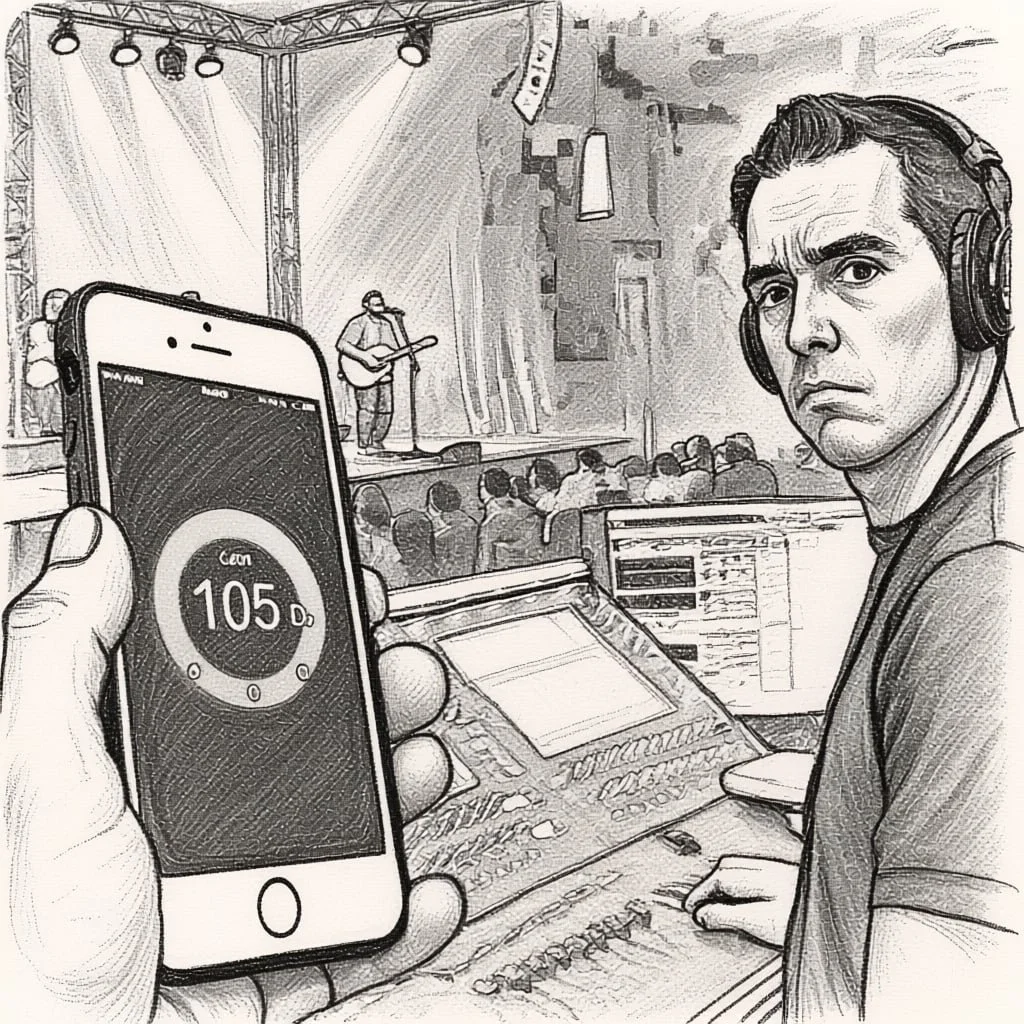
My daughter stared at me. “Dad… how long have you guys been tolerating this?” She wasn’t guessing. At the time, she was working as a sound engineer. She pulled out a decibel meter. Peak levels were hitting 105 decibels.
She shook her head. “You know below 85 dB is considered safe. This is dangerously loud.”
So we went back into the lobby, found some earplugs, and put them in tight. We were able to enter this time. We sat in the back as far away from the speakers as possible.
I walked toward the sound booth to show the technician the readings on my sound meter app. It said 105 dB.
He glanced at me. Then at the meter. Then back at me.
He rolled his eyes, turned away, and went back to what he was doing.
Not a word.
No “How can I help you?”
No apology.
No explanation.
No acknowledgment.
But the message was unmistakable:
If you don’t like my music, that sounds like a “you” problem.
How dare you come into my space and tell me what to do?
You crossed a boundary the moment you questioned the volume
The comfort of the audience—and the safety of their hearing—did not even register as a factor. That was the moment it finally clicked.
I’m an ear surgeon.
I’ve spent decades treating hearing loss, tinnitus, dizziness, ruptured eardrums, cochlear disorders, and the quiet emotional devastation that occurs when people begin losing their connection to the sounds they love. I’ve implanted cochlear implants into profoundly deaf patients. I’ve watched people cry when they heard a loved one’s voice clearly again. I’ve sat across from musicians who could no longer tolerate sound, veterans whose ears rang relentlessly after years around aircraft, and older couples drifting apart because one spouse could no longer follow conversations in restaurants.
And yet somehow, despite all of that, I had normalized what was happening right in front of me.
Or maybe “normalized” isn’t the right word.
Yes, deep down, I knew something was wrong long before that moment. I had many reasons to. And for sure, I noticed the rising decibel levels becoming more and more uncomfortable. I was already struggling with this thing called hyperacousis. But I was part of the “in-crowd”. The people running the show were my friends. So I tolerated it. I even defended it. Perhaps I had simply become numb, fallen in line with the culture, and suppressed the need to say something.
And it took my daughter—an enlightened professional sound engineer—and the dismissive disregard of a not-so-enlightened sound technician to finally open my eyes… and ears.
Because when it comes to protecting hearing at most music venues, nobody is really driving the bus.
I walked away dejected.
We kept our earplugs in and endured the rest of the service. At the end of the service, I made my way to the front to see my friend who was the leader on stage that day. He lit up and said, “Hey John! Great to see you! How are the kids? How’s it going….?” We made some usual small talk… and bantered back and forth.
Then I brought up the sound levels.
His entire facial expression changed.
It was as if I had punched him in the stomach.
He stammered out: “Uh… don’t look at me. You’ll have to take that up with the main campus music director… gotta go…” And then he walked away. Clearly, I had touched a raw nerve.
After that encounter, I went straight to the top and called my friend the Senior Lead Pastor.
He was kind. Apologetic. “Sorry about your experience,” he said. “We’ll look into it and turn it down.”
And for one week, they actually did.
The music was noticeably softer. I thought the problem had been solved. But gradually, week after week, the loudness crept back.
The bass returned.
The chest pounding returned.
The discomfort returned.
Eventually, we requested a meeting with the campus team and music director.
We spoke calmly and respectfully about sound levels, hearing physiology, discomfort, and the number of people quietly leaving.
They listened politely. Then one of them said two things that effectively ended the conversation:
“Before we go any further, please don’t expect us to make changes based on anything you are saying.”
And then: “Besides, I’ve never heard of anyone leaving the church because of loud music.”
Really? Seriously?
How can that be? Dozens of patients have complained to me.
And in that moment, it dawned on me. Of course. No one complains to you because you are one of the leaders. You are their rock star! You set the tone. You set the culture. You define what is normal. Who is going to question you?
It is a simple case of confirmation bias.
People who enjoy loud music usually do not complain. And people who are bothered by it are often embarrassed that they cannot tolerate what everyone else seems to consider “normal,” so they leave quietly. Sometimes they wonder: “What’s wrong with me?” People stop complaining when they believe nobody is listening. Eventually, they simply disappear.
But many of them do tell their ear doctor. I know, because I have stacks of charts from patients who quietly walked away without telling anyone else why.
To better understand the issue, I started “off the record” polling staff, volunteers, and attendees.
Roughly half thought the music was too loud. The other half thought it was “just fine.” Interestingly, not a single person thought it wasn’t loud enough. Some reported repeated hearing warnings from their Apple Watches during services.
Some employees and volunteers quietly pulled me aside and whispered: “I need to be careful here. Please do not record or mention my name.” “I don’t want to get in trouble.” “You’re never going to change the volume there—it comes from the top.” “And yes, to answer your question, it is way too loud!”
What surprised me most was what happened next.
Several people who initially thought the volume was fine later came back and said: “Now that you mentioned it, it actually is too loud. I never noticed before—but now I can’t unhear it. I guess I need earplugs.” The volume hadn’t changed. Their awareness had.
That realization sent me deep into the research.
I dove into the nerdy science—synapses per hair cell, oxidative stress, excitotoxicity, inner-ear chemistry, and hidden hearing loss.
Imagine practicing ear medicine for thirty years and then suddenly realizing how much more there was to learn about how the ear really works… and how fragile those hearing nerve connections truly are.
I began re-learning OSHA and NIOSH exposure standards.
How long is considered “safe” at a given decibel level?
Who regulates this?
Surely someone was protecting audiences.
I researched the laws and rules that govern noise exposure. I assumed that if I dug deep enough, I would eventually find the people responsible for driving the bus when it came to protecting the public’s hearing.
I had initially assumed the people controlling the volume understood hearing health.
I assumed they knew the safety limits.
I assumed there were real rules—rules that protected the people sitting in the seats.
I assumed too much.
There weren’t rules.
In the United States, there are essentially no federal or state laws limiting how loud concerts or worship services can be for the audience.
None.
Occupational regulations do exist—but they apply primarily to workers such as musicians, sound engineers, and venue staff. Under OSHA regulations, employers must implement hearing conservation measures beginning at average sound levels of 85 decibels, and hearing protection becomes mandatory for employees at 90 decibels. These standards were created decades ago to reduce classic industrial hearing loss—not the more subtle nerve damage we now recognize from repeated loud sound exposure.
But for the people in the audience?
For families.
For children.
For older adults.
For people who came seeking peace, healing, worship, joy, or connection?
For them, there are no meaningful exposure limits at all.
Ironically, the only enforceable sound regulations most venues encounter are local noise ordinances—and those exist mainly to protect the neighbors, not the audience.
Sound is regulated based on how much escapes the building.
Which means, paradoxically, the better insulated a building is, the louder it can be inside while still remaining fully compliant with the law.
In effect, the system protects the people outside the building… while those inside may be exposed to whatever sound levels the technicians prefer.
No one set out to hurt anyone.
But it goes to show:
you don’t know what you don’t know.
I prepared long and hard for a meeting with the Senior Lead Pastor of my church, armed with what I believed was overwhelming scientific evidence. I played the meeting over and over in my mind. I imagined him saying:
“Wow… my goodness. What amazing information. It must have taken you a long time to compile all of this for us. I had no idea the newer research showed hearing damage could occur at levels lower than we once thought. Thank you for bringing this to our attention. We need to take better care of our people’s hearing. This is incredibly valuable information.”
But that’s not how it went.
My wife and I were brought into the main office. The Senior Lead Pastor and his wife were there.
Of course, we went through the usual opening conversation.
How are things going?
Where are the kids these days?
We want you to know how much we love you guys.
But before the real conversation could even begin, he smiled and said in the sweetest possible voice:
“Before we go any further, I want you to know—we’ve already turned the music down as much as we’re willing to, and we’re not turning it down any more. We have a certain vibe we’re trying to create. We make it loud on purpose. We need the music loud enough so people don’t hear themselves—or the person next to them—singing off key. That kills the Spirit.
And please stop going around interviewing people about how loud it is and riling people up. If you have concerns, come to me first.
Now… was there anything else you wanted to talk about?”
That was it.
Mic drop.
The meeting was over before it even started.
In that moment, I went from being a trusted advisor—the pastor’s personal ENT doctor—to “that guy.”
The dreaded killjoy.
The complainer.
The man ruining the vibe.
Not someone bringing information.
Not someone trying to protect people.
But someone bringing inconvenience.
And just like that, I was dismissed.
We tried attending a few more services, but the music was still unbearably loud. We tried earplugs, but the thumping in the chest was still too much. We could not bring friends. We could not find peace.
I also realized that I could not teach about the importance of ear protection and safety to my patients and then subject myself and my family to levels 10 times to 100 times louder than my recommended safety limits. I would be a hypocrite. That would be like the school bus driver safety officer not wearing a seat belt!
We simply had to stop going. And suddenly, we found ourselves without a place to call home—not because of theology, doctrine, or community…
…but because of sound levels.
It was devastating.
As we searched for a new church, we discovered that most modern churches intentionally turn up the volume. Some more than others. After visiting several candidates, we found that nearly every service required ear protection. Few seemed willing to discuss the loudness issue.
So, wallowing in discouragement, I resigned myself to simply staying quiet and wearing earplugs to every service.
It felt like a lost cause.
Then something unexpected happened.
Friends in high places started coming out of the woodwork, quietly sharing their own struggles with loud sound exposure.
Some were television personalities.
Some were YouTube influencers.
A few were household names.
There were well-known rock stars.
Movie producers.
Musicians.
People I never expected.
They came alongside me and encouraged me to do something. “You’re the ear doctor. You’ve done the research. Be the voice that helps protect people’s hearing.”
“Let’s make a documentary.”
They galvanized me.
And slowly, I began to realize something important: The problem wasn’t just churches. It wasn’t just music venues, bars or restaurants. And it wasn’t just sound engineers. It was ignorance.
People were being exposed to potentially damaging sound not because they were reckless—but because they simply did not know.
Some were enduring it.
Others were celebrating it.
Almost no one understood the biology.
And if an ear surgeon with decades of experience could miss this…
what chance did everyone else have?
That was the beginning of EarAware.
Not a movement built on anger.
Not an attack on churches, musicians, or sound engineers. But an effort to close the gap between what modern sound systems can produce… and what the human ear can safely tolerate. A way to make the invisible visible. A way to explain hearing science in plain language.
Because until that gap is closed, some people will continue suffering harm while others continue celebrating the very things causing it—without realizing they are walking the exact same path.
Most people simply do not know.
And once I finally understood that… there was no going back.